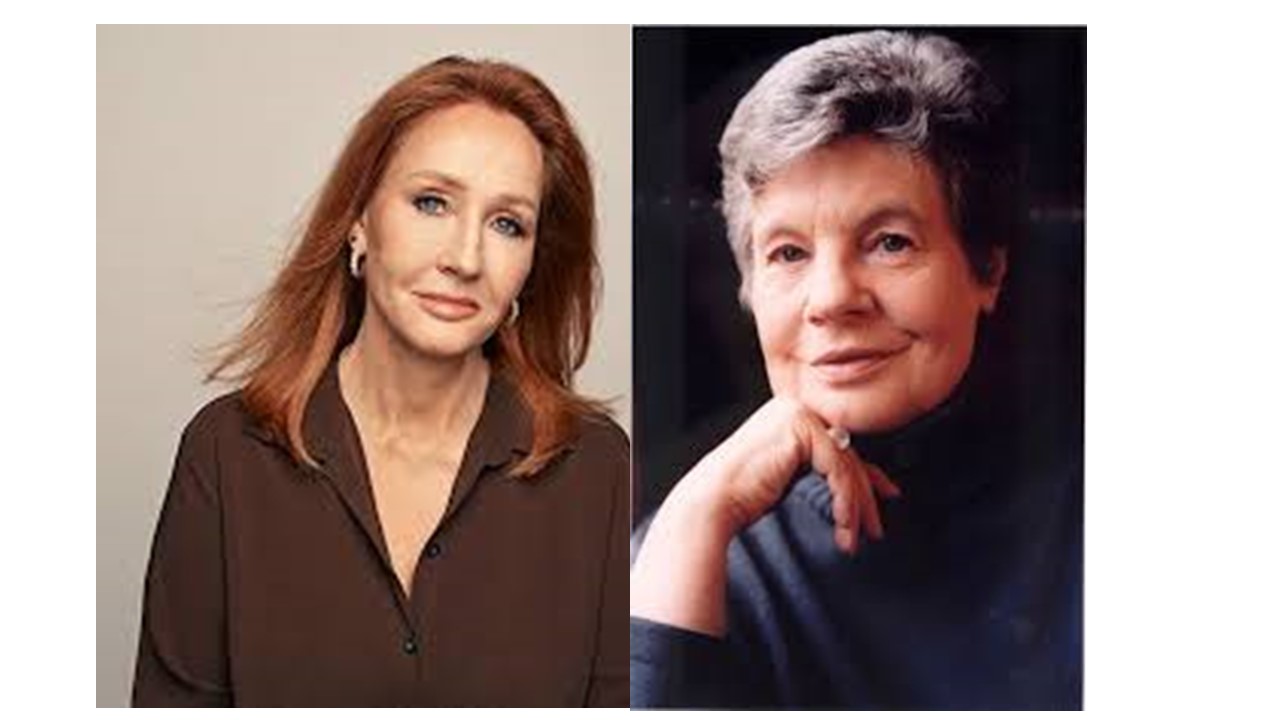
This bit of whimsy brings together two surname-sharing characters created by two famous but very different British authors. No, three!
Here is an explanation of the genesis of this piece, written over 20 years ago.
On July 11th, The Guardian reported the broadside fired at J.K. Rowling, the author of five best-selling books about boy wizard Harry Potter, by the novelist A.S. Byatt in the New York Times. A.S. Byatt, the author of four weighty novels about the formidable Frederica Potter, accused J.K. Rowling of giving her readers derivative stories that lacked a full sense of magic.
That A.S. Byatt should have taken up her pen on this issue merits an explanation. Is it really the issue of magic? Possibly. Magic makes its way into the third and fourth of her Frederica Potter novels in the form of a Tolkien-like children’s book within a book. As if to emphasise the importance of this magical thread in her fiction, the title of the last book in this series, A Whistling Woman, derives from this tale. A.S. Byatt, like J.K. Rowling, is in the business of writing magical stories, this argument might go, and sees herself as conducting some sturdy Defence against the Bad Arts.
I am not convinced. Nor am I convinced that A.S. Byatt is motivated by churlishness, snobbishness or jealousy as her critics have claimed.
I have had the considerable pleasure of reading all of J.K. Rowling’s Harry Potter books and A.S. Byatt’s Frederica Potter novels twice (one should not hide one’s Colossus-like straddling of the world of literature) and I believe I have the explanation for A.S. Byatt’s chagrin. She, the unashamed intellectual and artist, has made a fundamental authorial misjudgement in her magnum opus and is piqued with herself. What this error is becomes clear when one puts aside the controversy she stirred and, despite her voluble protestations, brings A.S. and J.K., Harry and Frederica together:
Harry Potter was a wizard. At least, he would be a wizard when he had completed his studies at Hogwarts School of Witchcraft and Wizardry. ‘At least,’ thought Harry, ‘I would’ve been able to practise wizard’s spells if it wasn’t the holidays.’ Pupils of Hogwarts School were forbidden to use magic when at home. Harry walked down Privet Drive disconsolately. Number four Privet Drive was where Harry lived in the holidays but he could not think of it as home. Home was where your parents lived. Harry’s parents had been killed by the evil wizard, Lord Voldemort. He now lived with his Uncle Vernon Dursley and Aunt Petunia and they went ballistic if Harry even mentioned his wizarding parents, James and Lily. There were no other Potters in his life. Oh, he had good friends at Hogwarts – Ron and Hermione were the best friends anyone could have – but no family. No Potters.
****
Family. Frederica Potter, her flaming hair now streaked with ash, thought about the families to which she had belonged since her ‘50s childhood in Yorkshire. ‘Belong’ – such an inclusive word until tilted back into the past tense when it denoted the opposite. This undistinguished suburban street meant families. The determined symmetry and sameness of its houses filled her with a profound horror that quickened her pace. Nuclear families. The nucleus, held together by the strong nuclear force but, apply the right stimulus, and it shatters with incredible force. Frederica had belonged to a nuclear family. What had held her highly charged father and neutral mother together? Bill and Winifred, grandparents to Leo, both now dead, interred. (Even in the emptiness this thought evinced, Frederica savoured the word’s Latin root. Root, earth. A satisfying connectedness.) Her sister Stephanie, also highly charged, long dead. And pale brother Marcus – a neutrino perhaps?
Then there was the other family in the small Kennington flat. Such arrangements are called woman-headed households these days, thought Frederica. Two women, Frederica and Agatha, one child each. That was no more, too. Agatha was now famous and rich on the back of books of magical tales. Those tales had held the family (children and adults) together as Agatha read them in instalments on Sunday nights. Now, since Leo, Frederica’s son, had moved to the USA (‘where all the real intellectuals of England go nowadays’, he had said) to pursue a career in the philosophy of science under the influence of Popper, Penrose and Peacocke, she had no family. (Frederica’s mind skidded past the dreadful, melodramatic death of her second son, Luk’s child.) She had thought she was Lessing’s free woman. No Lessing, she now felt, only lessening. No Potters, only pottering. Pointless pottering down soul-starved streets.
***
Harry walked faster. Aunt Petunia would have a fit if he was late for tea – even if she only ever gave him dry toast while her enormous son Dudley ate massive steak rolls and mountains of fudge. Harry wished he could just jump on to his Firebolt broomstick, slalom through the identical chimneys of Privet Drive and zoom down the one on the roof of number four. The punishment there would be! But it would be worth it just to see the looks on the three Dursleys’ faces. He was hurrying past the gate of number six when – CRASH!
Magic – that was a word to conjure with. Frederica smiled ruefully at the tricks the mind plays – ‘even at my age’ – as she hurried on. Agatha had found magic. But Frederica understood herself well enough by now (64 years old ….. ‘will you still need me?’) to know that it was connectedness that she sought, not magic. Understanding, a theory of everything. Physicists chased that and missed the human. Biologists – even deep thinkers like Luk – were as earthbound as the nematodes they studied. Theologians lost it at first base. (The influence of the USA is all-pervasive these days, thought Frederica, thinking simultaneously of metaphor and of Leo.) Perhaps only novelists could encompass it all. Thomas Mann with The Magic Mountain. Magic again! Any other novelist post-Eliot…..?
At that moment there was the dull thud of flesh hitting flesh. Frederica, knocked backwards by the force of the impact, felt her ankle twist sharply and a tearing pain in the old jagged scar on her calf. An image of Nigel, her brutal but sexually adroit ex-husband who had inflicted the injury with an axe, swam through her consciousness. Heavily, she hit the pavement and a small body landed on top of her.
***
‘Oh dear, what have I done,’ cried Harry, retrieving his glasses from the road. Frederica looked at her injured leg. Great gouts of blood were welling up from a gash in her ankle. ‘Can I help you?’ he said anxiously. Blood, always blood, thought Frederica with a mixture of despair and anger. Menstruation, childbirth, the Blood of Christ, poppies. ‘Here. Here’s my hankie,’ said Harry, tying it tightly round her leg. Frederica escried a zig-zag motif on the boy’s white handkerchief. ‘A present from Hagrid,’ Harry explained. Although almost faint with the pain, she lifted her eyes to her interlocutor’s face. A thin boy with fern-green eyes, a syzygial zig-zag scar on his forehead. (A vision of two identical blond heads and burning crossed Frederica’s mind’s eye.) What had this boy suffered?
‘That’s better, I hope?’ Harry asked, moving his hands away from her leg with the delicate finger movements he had seen Madame Pomfrey do in the sick bay at Hogwarts. The Ministry of Magic couldn’t object to a little bit of magic to help this old Muggle, could they? Her severe expression softened. ‘That feels better,’ she said. The old Muggle was quite bony. Her face had a hungry look, Harry thought.
In mitigation of his part in the collision, Harry offered ‘My name is Harry Potter.’
She said, with a surprised smile, ‘That’s strange. I’m also a Potter. Frederica Potter.’ ‘Potter is a common name in England, isn’t it?’ asked Harry, thinking of his parents.
‘Not in English novels,’ said Frederica, exploring the apparent coincidence further. She sat up.
Harry sat next to her on the pavement. ‘Why would a writer give the name Potter to a main character?’ asked Harry.
‘It is a plain name, isn’t it?’ agreed Frederica, who was feeling a lot better. ‘No heroics attached. Potter – potty…’
‘Under the bed or loopy,’ grinned Harry.
‘Pottering, potting….’
‘Gardening.’
‘Pots…’
‘And pans in the kitchen.’
‘Pottery’
‘More creative. Are you a writer?’ Harry looked into Frederica’s narrow, angular face.
Frederica was well versed in this area of self-appraisal. ‘No – more of a teacher.’
‘Oh’, said Harry, disappointed. ‘The only grown ups I ever seem to speak to are teachers, except for Hagrid.’
‘But I’m not your teacher’, insisted Frederica, touched. ‘I hardly speak to children now that my boy has grown up, Harry.’ Looking at this boy, Frederica experienced hot, hot waves spreading as from an Icelandic geyser from the crown of her head to her throbbing ankle. ‘No, no! That’s not true:’ as the warm tears flowed ‘I had a second son named James. He died…..’
‘Your son….. he was called James…..Potter?!’ stammered Harry. His eyes widened and his heart beat inside his chest like the wings of a giant bird.
‘No!’ cried Joanne Kathleen (or was it Agatha?)
‘Stop!’ demanded Antonia Susan (or was it Frederica?)
‘Ho! Give us a chance.’ A portly figure in a policeman’s uniform was seen puffing, grampus-like, up Privet Drive. ‘Harold Potter at your service,’ he said shaking Harry’s hand with gusto and giving Frederica an affable peck on her moist, lined cheek. ‘The latest in a long line of Harold Potters in the force, going back to old Lord Ickenham’s time. He was quite a lad was Pongo Twistleton’s Uncle Fred, so my grandfather told me. What he didn’t get up to at Blandings…..’
Joanne Kathleen looked at Antonia Susan as Pelham Grenville, smiling, twiddled his pencil: ‘Why did we choose Potter?’
Cape Town
21st June 2003