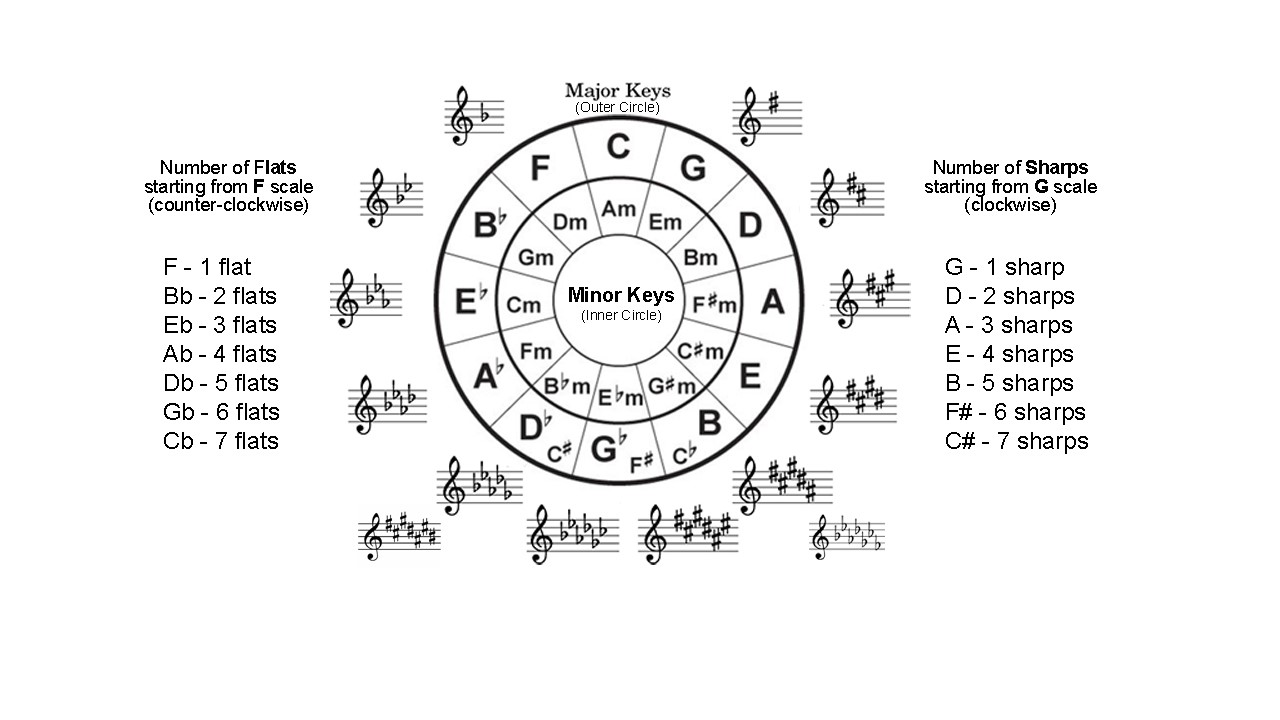
Twenty ago I produced a set of programmes for Fine Music Radio based on the musical keys. It began with C major and ended with F sharp and G flat majors. At that time, music in most keys produced specific emotional responses within me or conjured up metaphorical pictures. For example, D major was bright like burnished wood and B flat major was brassy and bibulous.
Soon after that, things began to change – I began hearing some music at the pitch that was not in the original key of the music. This happened with some keys more than with others, and with those changes came a loss of some of those associated feelings and pictures. The pitch I was heading was moving upwards in relation to the actual pitch of the music being played. I discovered that this can be part of presbyacusis i.e. changes in auditory perception brought on by the aging process. It can also be brought on by certain medications such as carbamazepine. It may happen to many people but only those with a perception of keys (perfect pitch or near-perfect pitch and musical training) will be able to identify or recognise that such a change is taking place. So this seemed to be something that I would need to live with.
I thought it would be worth chronicling my experiences and will do so here. I had a set of stories from the last decade on another website but that has become inaccessible and the stories were missing from the back up. (But see below for some excerpts that I have serendipitously found.)
Most changes involve the music having moved up a semitone. For example, pieces in E major (a rich warm key to my perception) are mostly now heard in F major (a light key) these days. A major loss. [Well, A major has moved to B flat major, a complete alteration in its meaning – a true A major loss.]
At an earlier stage, pieces would begin in the correct key, but I’d notice at some time into the piece that the change into the higher key had occurred. Now, from the very start, they are in the new key.
24th February 2026 – Bruckner’s 7th in F major
It isn’t. He wrote it in E major. Thanks to a kind relative, I was able to attend a recent performance of this gargantuan work at the Cape Town City Hall. I know it well enough to listen for certain things and enjoy its structure. After the interval, we hushed so that Bernard Gueller could conjure tremolando strings out of nowhere. He did, but, for me, not in E major but in F. Not ineffable, but not unexpected. So be it, my soul said. Enjoy what is left. The outer movements both end with an enormous crescendo as the whole orchestra joins into climactic phrases in the home key, all being fulfilled in an enormous chord. Key does not matter at this point – enormous tonal sound does.
Movement 3 is an energetic Scherzo in E minor with lots of trumpet work. I did not notice which key I was hearing the music in. Simply enjoying it, until in the repeat I thought, what key am I hearing this in? It wasn’t clear until the end when I could discern F minor, a flat key, and visualise the harmonies as they shifted in that key.
E major (or not) has haunted me this week. When running this morning, I Iistened to BBC Radio 3. I joined the broadcast during a string quartet that I did not know. How nice – it’s in E Major. It came to an end, and I was pretty sure I’d been tricked and that it was in E flat major, a semitone below. The announcer confirmed this. I got a free dose of my lost key. Later on, Cecilia Bartoli joined my run, singing Rossini’s Una voce poco fa. At one point a run (sung, of course!) took her right down to G sharp below middle C. Ah, I said as I woke to the key, she is singing in E major. Isn’t that Rossini’s original key? Why was I hearing it ‘in key’?, which I did till the aria was over. Had the diva recorded it in E flat major? Or a period recording where the pitch is lower? I shall have to find the recording and check. My suspicions were enhanced when the next piece was Mozart’s Piano Duo in F which was clearly in F, F major being one of those keys that is slower to shift in my hearing than many other keys.
Update 30/06/2026: I located the Cecelia Bartoli recording. According to our piano, compared to concert pitch E major, the recording is about a quartertone flat – flat enough not to trigger the key change in my brain.
14th February 2026 – 6 of one does not equal half a dozen of the other
We were listening to and watching a compilation of St Valentine’s Day music videos. One piece was Schubert’s Impromptu in G flat major which is largely played on the piano’s black keys. G flat major is a rich multiple flat key, very calm and even. When the Impromptu started, I did not have my eyes on the screen; I heard in it in G major (i.e. a semitone up) which was not a surprise. The more complex keys (G flat major has 6 flats) were the first to slip upwards into more familiar keys such as G major with one sharp as my key perception shifted. The camera shifted to the pianist’s hands. I wondered if an old phenomenon in this transition could be activated. A few years ago our daughter was playing the second movement of Beethoven’s Pathetique Sonata. This lovely movement is in the delicious key of A flat major. By then most pieces in that key were heard in the much blander (characterless?) sharp key of A major. As she played I heard it in the sharp key, but when I looked over her shoulders at her fingers on the piano keys the music’s sound shifted immediately into A flat major and stayed in that key when I moved my eyes away for as long as I kept listening.
With the Schubert, eyes fixed on the pianist’s fingers, I willed this to happen and eventually it did, but oddly my brain heard the Impromptu in the key of F sharp major, not in the written G flat major. In terms of the sound frequencies being generated from the piano, these two keys should produce the same sound since F sharp and G flat are the same note on the piano. My sensory sound correlation system told me that the notes were sharps, not flats – a key signature of 6 sharps, not of 6 flats. That was a new event in my ‘Pitch Imperfect’ aging process.
PS: When I play the piano I hear the music in the correct key, whether my eyes are on the printed score, on the piano keys or closed. The shape of the music under my fingers is so wedded to the keys that I have known since my childhood that the altered systems of my older auditory brain can’t (yet?) overcome that imprinting.
15th February 2026
Here is an excerpt from my older posts – the stimulus occurred then on St Valentine’s Day in 2013.
With Thanks to St Valentine
“Last night we went to a concert presented by the Cape Philharmonic Orchestra in Cape Town’s City Hall. It was a trial getting there owing to the residuum of the major traffic disruption that accompanies the opening of South Africa’s parliament. But after that we settled down for an evening of Romantic music – it was St Valentine’s day after all.
First on the bill was Cesar Franck’s Symphonic Variations with Yulianna Avdeeva as the pianist. F sharp minor is the key with a shift to F sharp major intermittently and a brilliant ending in the latter key. Since F sharp major is one of those complex keys with multiple sharps and because I am now ready for the effects of my new tonal perception, I was not surprised when the latter part of the work sounded as if the musicians were playing in G major, a semitone up. Gone was the pleasure of the black note feeling of F sharp major. From where we were seated, we could not see Avdeeva’s fingers. Perhaps my brain would have shifted my tonal perception back down a semitone if we had been able to see her fingers skating over the black notes in Franck’s skittish final variations.
Next on the bill was Chopin’s 2nd Piano Concerto, in F minor- Avdeeva allowing herself to perform two works in tandem! I was ready for the wonderful four flats, the full round gorgeous key of related A flat major to sound in the non-descript key of A major, one of my least favourite keys. Usually after the permutations and perturbations of the development section of sonata form (as in the Chopin 1st movement), the return of the main themes in the recapitulation is associated with the upward shift I have come to expect. Miraculously and gloriously this did not happen this time. And more wonderful to relate, neither did the A flat major slow movement shift. Its A flat minor (7 flats) restless middle section did go to A minor (no flats or sharps), but, again miraculously, the return of the beautiful main theme was solidly and beautifully in A flat major. The finale did not shift either, allowing the horn to call in F major, not F sharp major, to herald an exciting end to the concerto. Avdeeva was induced to give us an encore (she had played beautifully, a real treat). She chose Chopin’s Valse Brilliante in A flat, and in A flat it was!
So why these differing experiences? What was happening? It cannot be a pitch or frequency phenomenon as the orchestra did not re-tune to a lower pitch and piano certainly did not! It was not an act of will on my part. I cannot will keys not to change – I have tried.
This morning I put on a CD of the Chopin 2nd movement and before long I heard the sound of E dominant 7th which told me that A flat major had shifted up to A. So what was special about last night? Let’s give thanks to St Valentine and be content.”
5th June 2026
My Valentine’s Day post above was about the keys of G flat major and F sharp major and Schubert’s piano Impromptu in G flat. I found a musing of mine from 5th November 2011, a window into an earlier phase of Pitch Imperfect:
Losing F sharp major
This may sound dramatic. How can one lose a musical key? What door cannot be opened if one has lost this kind of key? Interesting metaphor!
My daughter was teaching herself to play Schubert’s wonderful Impromptu in G flat major. This rippling piece of contemplation with its brief but fully resolving shifts into the minor is one of the pieces I used to illustrate the link of the mirror keys of F sharp major and G flat major in the Keynotes programmes. The two keys sound exactly the same as they are based on the same note, G flat and F sharp being the same. in the Keynotes programme I link them to the infinite and the eternal.
It sounded as if my daughter had decided to simplify the piece by playing it in G major – exchanging 6 flats for 1 sharp. I was hearing it in G major, a semitone higher. She was playing it in the written key. So I seem to have lost that piece’s emotional content. G major to me is light and bright, and this Impromptu cannot work for me in G major.
This evening I listened to some Haydn I had not heard before. The second movement of his keyboard trio number 26. Key F sharp minor. It was in G major (I thought). Very pleasant Haydn, relaxed but not deep. Unusual to choose G major for a second movement in a work in F sharp minor, but Haydn was an innovator. But then the music moved to the finale. In G minor! It could not be G minor in a Haydn Trio in F sharp minor, of course, but that was how I heard it and envisioned the notes of this minuet-rhythm music in a minor key. With that, I realised that I had been cheated of hearing the slow movement as Haydn had intended it. The only way I am going to hear it in F sharp major, the written key, is to digitally manipulate it.
I have subsequently done an experiment on myself: I sat at the piano and played the Schubert myself. With my fingers on the black keys as demanded by Schubert I heard it in G flat major. I closed my eyes and it was still in G flat as I played. Presumably the sense of where my hands were told my brain to hear G flat as G flat.
Another nuance has appeared as she tries it out again. It sounded in G major before supper. When she went back to it after supper, it was in G flat. So – sated, I hear it differently!
Perhaps I should listen to the Haydn after a meal.
So perhaps I haven’t lost a key: it is intermittently missing…..